Friday, April 22, 2011

Day 5 Quote 4: The Engine Which Drives Enterprise Is Not Thrift, But Profit

Quote 4: The Engine Which Drives Enterprise Is Not Thrift, But Profit
 – John Maynard Keynes

I find it amazing that even though I’m just in my 4th quote, everything is actually very familiar to me. The quotes seem to share a common language that I understand.

It’s much similar to the “Parable of the Talents (Matt 25: 14-30).” Three servants were given talents by their master. After a period of time, their master summoned them again. He [master] was very pleased to see that the 1st and 2nd servant increased their talents. However, to his dismay, the third servant kept his talent and didn’t do anything to increase or use it. He just buried it.

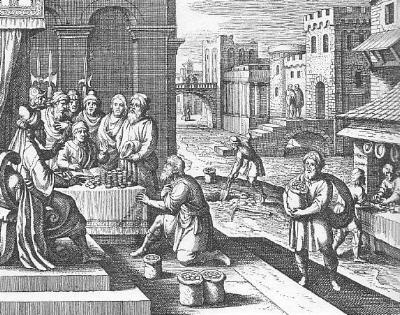


Here’s the basic moral lesson:
If you have a talent [money], don’t keep it to yourself…Use it! Invest it! Grow it!

Going back to what I said earlier that these quotes all seem to share a common language. Much similar to the three servants, these quotes [talents] are given to us not to be kept or hidden but to be used.  There’s a lot of information available in the world; what sets people apart from each other is how they use these information. Quotes are a perfect embodiment of this. It [quote] speaks to us and is made available to us…but the manner of how we understand, use and apply it will definitely vary. You may have all the information in the world but if you just ignore it and don’t do anything about it…I have one thing to say to you:

You’re useless!

This is just what the quote says…thrift or savings may be good since it gives you a safety net during times of trouble; but, looking at the bigger picture, if you keep saving and saving…you actually end up with nothing. If what you have now is similar to what you have 3 years ago, you actually have nothing. Nothing in a sense that you didn’t do anything to improve yourself…again, nothing ventured, nothing gained!

That’s why profits are the engine that drives enterprise… because they constantly have to stay competitive and ahead of the pack, there is little room, if not zero, for doing nothing with the resources that are given to them.

I am not discouraging you from saving. I still save. Saving is good; but the thing here is that you shouldn't just keep saving your resources (money). You should constantly look for ways to make it grow. Before, I thought that if I wanted to buy something that is expensive, I would need to save up on my allowance. This is a very common practice.We save up our money to be able to buy something that costs more than what we already have. A car for example. For me, I want to buy a mini cooper (similar to the ones they use it the Italian Job movie) which costs around $30,000.

$30,000 is roughly around P 1.3M with a DP of 20%. Basically, I'll be needing around 260,000 just for the DP. If I save 10,000 of my salary per month, it will take me around 26 months or a little bit over two years. But, what if instead of just saving my salary per month, I invest a portion of it (if not the entire thing) on something that will give me profit. If I have a good investment portfolio and if the odds are with me, I can get P260,000 in less than two years. See the point?!

Simple tip: Always look for ways to make a profit given what you have!

Wednesday, April 20, 2011

Day 3 Quote 3: Cut Your Losses, and Let Your Profits Run

Quote 3: Cut Your Losses, and Let Your Profits Run
- Anonymous


This is definitely one of the most basic ideas that you have to instill in yourself.
Don’t settle for mediocrity!
If it’s pulling you down, let go of it! Go for something that will push you to the top…

But, this doesn’t give you the right to step on other’s shoes. It’s simply telling you that you should always strive for success. Don’t settle for what you have now; always try to push the boundaries. Improve yourself!


I recently talked to a friend of mine about perfection… it’s true that you can never be perfect. But, that shouldn’t stop you from chasing perfection. He told me that I should actually be thankful for the fact that I can never be perfect. It means that there is always room for me to grow. More knowledge to seek…more techniques to master… basically, making myself “more”. “More” doesn’t necessarily mean that you’re just learning more things it means “more” of things that matter to you and are of value to u.

We also talked about physically living and really living. Physically living is where you just live for the sake of living. You don’t do anything more… you don’t add anything to yourself or to the world. Really living is when you try to be “more.”

If you’re just going to “physically live” in this world, it’s better that you just not live at all. You’re sucking all the energies and resources in this world. You’re a waste of time!

So, please…do yourself a favor and do us a favor. Live!!! As in, Really Live!!!

I recalled another line that from one of the LG commercials… “Live Borderless”

Monday, April 18, 2011

Day 2 Quote 2 Continued

Only A Fool Holds Out For Top Dollar

Just wanted to add something....

I said that I like to take risks. If you don't risk anything, the chances of you getting that BIG prize in the end are minimal. Nothing ventured, nothing gained.

Although taking risks is commendable, it's also scary. If you take risks, there is that chance of being awarded the grand prize. But, what if the worse happens? Can you overcome it? Can you survive it? The prize may be very appealing but it's a complete 180 if you end up in the other direction.
Are you ready to take that leap?
Am I ready to take that leap? really ready?

Or maybe I shouldn't do anything at all... Say no to the present gain and say no to the future gain. Maybe none of the two options are best for me.  Come to think of it, it's really confusing. Should you go for what is being offered to you now? Should you go for what is being offered to you but is in the future? or should you wait for a totally different opportunity?

You're being asked to choose between option A or B. But, wouldn't it be better for you to just choose Option C?

I'm not sure if you're still following my trail of thought..but, think about it. In reality, the options that they give you are not the entire spectrum of paths that you can take. You have the decision to create your own option. To say no to them and say yes to something else. But still, there is that uncertainty that maybe that "something else" [or Option C] is not good for you also. In that scenario, you LOSE!

Whether you take Option A, B or C...there's is always that possibility of losing. Are you ready to lose? Am I ready to lose?

Right now...I'm still deciding.


Day 2 Quote 2: Only A Fool Holds Out For Top Dollar

Quote 2: Only A Fool Holds Out For Top Dollar
- Joseph P. Kennedy


Question: Would you rather opt for a guaranteed short-term gain or an unsure (but is definitely better) long-term gain?


Let’s say I’m giving you two options:

-         Option 1: I’ll give you a million pesos right now
-         Option 2: Depending on my mood, I’ll give you five million pesos or 0 pesos two years from now.

Considering the inflation rate, the second option still sounds waayy better. However, there is a catch to it – it can either be zero or five million. Yes, you can use the DCF (Discounted Cash Flow) equation to find out which option would yield a higher return. But in accounting for uncertainty (or, in this case, the chances of getting the “bokya” money), you would need to at least have a solid probability [of the chances] of either getting the five or “bokya” million pesos. Overall, what you can get is what’s called the “best estimate.” But since the differentiator or the decision maker is my mood (which is obviously qualitative), how you can logically decide what option is better? Or what is the “best estimate of returns”?

Going back, this is what Day 2’s topic answers. Only a fool holds out for top dollar! Following this thought, the risk of waiting for the five million pesos after two years is not worth it. You have to live for the now! Only fools turn down current opportunities in the hopes of receiving a very BIG opportunity in the future. It’s all about guaranteed success!

On the flip side, it’s also true that the biggest winners are fools! If you don’t risk anything, the chances of landing a BIG success are minimal. Risk Takers are those who defy the odds and take chances. They are the ones who have the guts to pursue something regardless if the cards are stacked against them. They seek for the bigger prize instead of settling for the small but guaranteed win.

But, be warned!

There are fools and there are smart fools. Fools are those who just keep on hoping for the promise of the future. Smart fools are who that still do the same but carefully analyze the situation if they have a realistic chance of getting the big prize in the end.

Smart fools are the true winners!


For me, I’d rather risk something than not risk anything at all. I love the thrill of chasing something that you are unsure of. It gives me a sense of an adrenaline rush. But, I still have to be careful as to what extent am I willing to take risks and if the prize in the end is all worth it.

I try to be a smart fool!

How ‘bout you? Do you want guarantees or do you want to be foolish? If you answer the latter, are you just a plain old fool or are you a smart fool? Pick a side.

Day 1 Quote 1: Buy Cheap, Sell Dear

Quote 1: Buy Cheap, Sell Dear
– John Greenleaf Whittier


This officially marks the start of the 365-day journey.

 “Buy cheap, sell dear.” Where have we all heard that before? It’s the most common line or rule used in the stock market.

I’ve been dabbling in stocks for almost 4 months now. From my perspective (that of the stock holder), when prices go up (higher than your acquisition price), you have to sell your stocks. That is the most fundamental way of earning a profit: buy low, sell high.


Sell it!!! But, to whom and how?

What is the most recent thing that you purchased? Why did you purchase it? Did you think about the price? (of course, you did) But, what else influenced your decision? This other factor is what I like to call the “umpf” factor.

Yes, price can be a factor in your decision-making. But, overall, you buy something because it’s important to you or because it adds some value to you. That’s what I like to call the “umpf” factor. It’s pretty simple. It’s the value of possessing it that makes you want to buy that product, service or any other thing that has a price tag.

It’s just a matter of weighing out which is more important:

-         The opportunity cost of spending your money on it instead of keeping your money or spending it on something else
   --> then don’t buy it
-         The opportunity cost of not having that object in your hands
       --> then buy it

This is where sellers strike the difference. Successful sellers are those who are able to position their products in a way that it appeals to their target market. In a way that makes the product very “dear” or with a high “umpf” factor to their market. 

  
Two sellers can sell the same product. Let’s say, bottled water. Everything is the same.
  
What will make you choose an Absolute water from a Wilkins water? A factor may be availability. If you go to a local sari-sari store, you don’t ask them for the brand of water that they have. You just tell them, “Isang water please.”

                                          Availability – that’s the “umpf” factor.

It’s that simple. Buy cheap and sell dear to earn profits. It’s not necessarily buying something cheap and then selling it with a high margin. It’s selling something at a price that is above your total unit cost (acquisition cost, overhead cost, etc.) in a way that emphasizes the “umpf” factor that your market looks for. Like for the bottled water example, make sure that you sell it at a price where you still make a profit. But, for your customers to buy that product make sure that you have a good logistics/distribution scheme.


 For the stock market example, the “umpf” factor is the type/nature/name of the stock. If it comes from one of the prominent companies (Del Monte, Ayala Corp., etc.) there’s a very good chance that you will easily be able to make a profit from your stocks.

Bottomline, buy cheap and sell dear. Choose your product. Choose your market. Find what makes your market choose your product over others. Find the “umpf” factor. Highlight it!

Thursday, April 14, 2011

Cheers to the start of something wonderful!


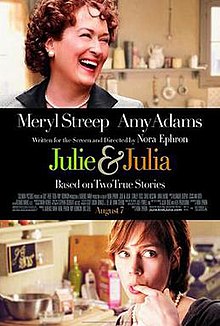
I recently watched the "Julie and Julia" Movie and was inspired by how a simple person changed herself for the better just by committing to do a task that required her time, effort and patience. She may have encountered problems along the way such as the temporary separation from her husband and several nervous breakdowns; but, overall, the journey and the end goal were all worth it.

I created this blog to pay homage to that. But, since I am not an avid fan of cooking, I'll dab into something else - something that's more in my neighborhood and have the knack for it. That's reading books and philosophizing about it! In my 4 years in the Ateneo (and even prior to that), I've always found a soft spot for asking the questions "WHY?" and "How does that relate to me, the society, family, etc.?"

This blog will be about all of those.
The first book on my list is the "MBA In A Book" (edited by Leslie Pockell). I will commit 365 days trying to master (in this case, philosophize) the 328 pages of the MBA in a Book.


I will go through the book page-by-page. And as a general rule, I will not read through the other pages while I'm still philosophizing about a certain page.

Good Luck!! I hope I pull it off.
Looking forward to the great journey and end goal ahead.

Day 1 Quote 1 - April 18, 2011
Day 365 Quote 321- April 16, 2012
***That's exactly 365 days (http://www.convertunits.com/dates/)


"It was character that got us out of bed, commitment that moved us into action, and discipline that enabled us to follow through"
- Hilary Hinton "Zig" Ziglar